According
to European myths and legends, the oak tree is related to
the masculine principle, and the lime tree to its feminine
counterpart. The Greek legend of Philemon and Baucis, for
example, tells of how Philemon was turned into an oak tree
after his death, and Baucis was turned into a lime tree, symbolising
their eternal love.
All French schoolchildren learn of how good King Louis dispensed
justice and medicine beneath an oak tree. This tree, the complement
of the feminine dance lime tree, was known as the “Oak
of the Constellations” . Unlike the dance lime tree,
which was planted in the centre of the village, the oak tree
was planted in a more out of the way place, outside the village,
and was place where wise men met.
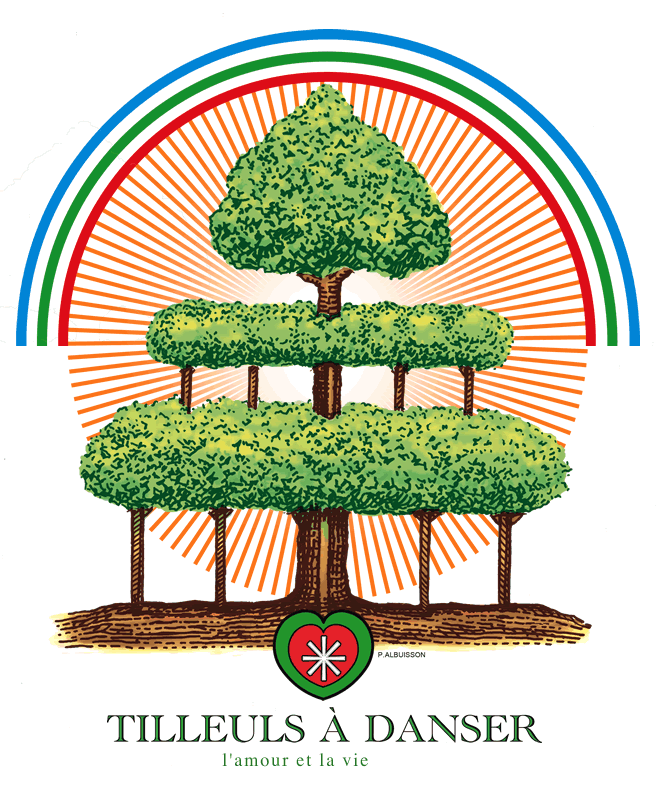
The three tiers of the dance lime tree represent the three
circles of the sun’s course at the winter solstice (the
shortest day of the year), the equinoxes (when the day and
the night are of equal length) and the summer equinox (the
longest day of the year). An X
can be traced between the northeast and the southwest, the
southeast and the northwest. This X-shaped
cross is known as the Cross of Taranis, or St Andrew’s
Cross. If another cross (+)
is superimposed along the perpendicular east/west and north/south
axes, a circle dividing the year into eight equal parts is
obtained. These divisions determined the times when the eight
yearly nature festivals of Europe would take place.
Our project’s goal is to promote the planting of dance
lime trees® in villages and urban communities throughout
Europe. |

Oak
of the Constellations
|