An ancient lime tree in Birnfeld (Germany)
click to enlarge

The dance lime tree, through its longevity, brings together not only different eras but also people of the present and the past. It forges a link between history, the temporal, and festivities, and unites nature and culture. It also opens the door to the new “green humanism” that is growing today in response to increased understanding of and concern for ecology.

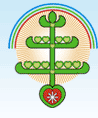
The heart-shaped lime tree leaf is associated with the heart and all its symbolism, which explains its association with the principles of Love, Fidelity and Justice. The dance lime tree is a “Tree of Love”.
A “Feminine Tree”, the lime often plays an essential role in myths, fairy tales, legends and in popular customs. Its popularity is legendary. The legend of Philemon and Baucis, for example, recounts how this couple was turned into an oak tree and a lime tree, which symbolised their great love for one another.

The lime tree is also associated with Freya, the Scandinavian goddess of love, and with Frigga, the goddess of medicine, who protects marriage and binds faithful lovers together. In Greek mythology, the mother of the centaur Chiron (who taught medicine to mortals) was called Philyra, which means lime tree in Greek. This tree, whose bark was used to weave textiles and make ropes, is by extension a “Tree of Ties That Bind”, linking together communities and individuals. The components of its bark, sapwood, leaves and flowers are used in many medicines, making the lime tree the king of the “Medicine Trees”.
In the epic poem the Niebelungenlied, the mother of the hero Siegfried is called Sieglinde. This name can be translated as “lime tree of victory”, “sweet victory”, or simply “lady of the lime tree”.
Drawings and graphics : Pierre Albuisson
Web Design : www.myartdesign.fr