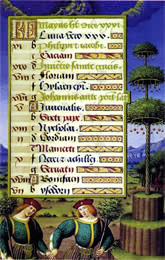
 Livre d'Heurs d'Anne de Bretagne.
 |
Les
Tilleuls à danser® relèvent d’une
très ancienne coutume européenne dont la plus
ancienne représentation qui nous soit parvenue, se
trouve dans le très célèbre Livre d’Heures
d’Anne de Bretagne (daté de 1508) conservé
à la Bibliothèque Nationale.
La
trace en est également présente dans l’œuvre
des peintres flamands, Pieter Bruegel le Vieux et Pieter Bruegel
le Jeune ainsi que chez Lukas Taffle.
Le grand folkloriste
et spécialiste de l’ethnologie française,
Arnold van Gennep, rapporte qu’à Lynde, une commune
du Nord de la France, on pouvait voir, à la fin du
XIXème siècle, un très vieux tilleul
à double couronne et aux branches enchevêtrées,
constituant une sorte de plateforme entourant le tronc. Quelques
rares et très vieux Tilleuls à danser figurent
encore dans plusieurs régions d’Allemagne, de
Belgique et Hollande.
|
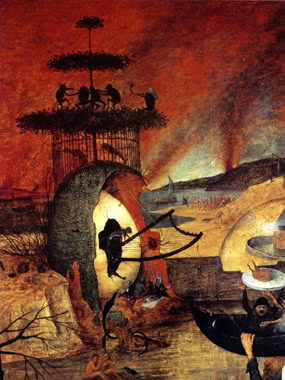 Pieter Bruegel l'Ancien, Margot (détail).
|
Les
Tilleuls à danser se présentent sous la forme
d’un arbre planté au centre du village qui offre
la particularité de posséder une ou plusieurs
plateformes soutenues par une charpente. L’usage de
danser sur celles-ci s’expliquerait par le fait que
les cordiers, utilisant l’écorce du tilleul pour
fabriquer leurs cordages, auraient créé des
plateformes dans les arbres afin de faciliter leur travail.
Investies par les villageois, ces plateformes seraient devenues,
au fil du temps, des lieux festifs où l’on prit
habitude de danser.
|